Movies as a vehicle for time travel: not so much.

Reading about the recently discovered graves of Roman gladiators and their lives, as best we can imagine them, I wondered if any movie can reproduce the experience of the past given just how much culture shapes our perspective.

What would a movie shot by a former gladiator look like? What would they choose to include in each shot, what stories would they tell? What would it sound like? Would it be of any interest to a contemporary audience or would it be thoroughly alien to us like an experimental film by a deranged director?

Can movies, with their abstract poetry, overcome the gap between them and us, then and now? Or is the past forever our prop house, for us to plunder like children playing dress up? Is there much archeology that would make us feel thoroughly uncomfortable — no longer ourselves?

I am reminded of the movies of Terrence Malick, the Cremaster Cycle, the power of instrumental music (like Erik Satie) which we cannot understand but are transported by.
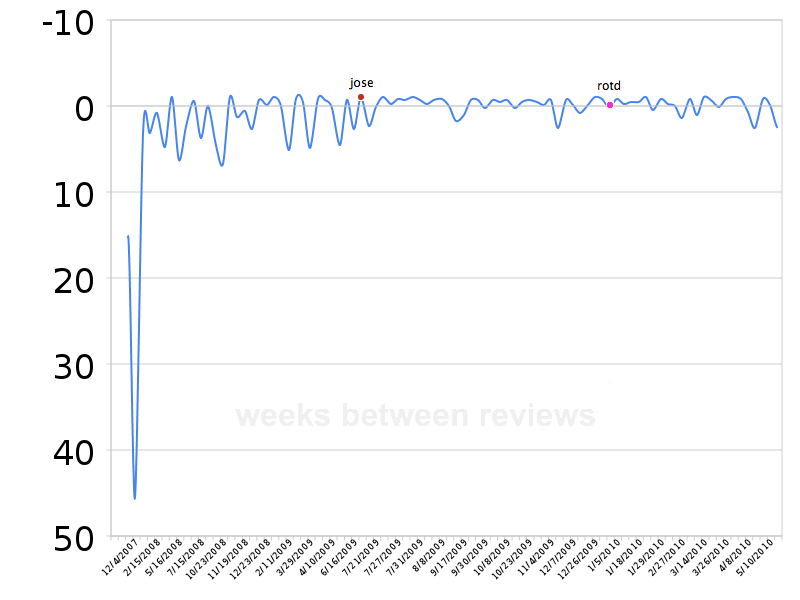
Yelp as a catalyst for business growth.

We first went to Al Watan, a great Pakistani restaurant by the airport, in June of 2009. By then, it had been reviewed 34 times on Yelp. It has since been reviewed another 60 times. As it happens, not only was I in the first wave of Yelpers to visit Al Watan, I visited right before it really took off.


weeks between reviews

As the graph illustrates, Al Watan was very popular among Yelpers who wrote reviews from July through August of 2009, in October of 2009 and then again from January through March of 2010. (I’ve noted that it was highlighted on yelp.com/la in a “Review of the Day” on January 5, 2010. You can see that this led to another increase in the frequency of reviews.)

I don’t think my review was the turning point that helped Al Watan become popular with Yelpers. But I also don’t see any evidence that it was a review on Chowhound or by Jonathan Gold that set off the Yelping frenzy as those non-Yelp references date back to 2006.

(In fact, when I made up my mind to first do the one-hour r/t drive to Al Watan, I did it on the basis of reviews on Zabinah.com – “your guide to Halal eating” – which recommended it for wedding catering, a hallmark of authenticity in my book.)

Perhaps, Yelp has data which would help me determine whether it was a particular user’s review that set off the Yelping frenzy. Perhaps, they know which reviewers have the capacity to make or break a restaurant – at least in terms of buzz on Yelp. That would be something to know.

An invention called anticipation.

Ana is making some beans. They smell great. Part of why they smell great is the feeling of anticipation. It is a feeling of pleasure set in the future. (Most of life is uncertain, but that which is anticipated can almost be tasted.)

Anticipation is pleasure transported from the future into the present. What a great invention!

You know it’s the future when digital db meters cost $1.

I just bought a basic digital sound level meter. For $1. Three years ago, it likely would have cost me at least $60. But because the one I just bought uses my iPhone as a platform, the vendor cuts out at least 98.3% of the previous retail price – i.e., the cost of designing, manufacturing, delivering and having retailers stock a physical, single-use device.

How will Radio Shack survive if not by selling apps?

La Banda Lavanda

Their adventures trying to make it as techno cumbia band with openly gay members. The Monkees meets Entourage with a twist of lime.

What kind of a girl do you think I am? Oh, that kind of girl.

The ads that turn up during election time are like exquisite pick-up lines. What kind of a girl do you think I am? Oh, that kind of girl.

I just read an ad for a measure that calls itself the “Taxpayers right to vote.” It’s utter bullshit. Tourists from China pay taxes. Legal and illegal residents pay taxes. Corporations pay taxes. Taxpayers don’t have a right to vote. Citizens have a right to vote.

But citizen is too fair a term. It implies diversity. A lot of those people are citizens. Whereas taxpayers implies those with means – or just mean people who resent having to pay for government services. The latter, of course, are the perfect dupes for this come-on:

This measure places new voter approval requirements on local governments before they can use “public funds”—defined broadly in the measure to include tax revenues, various forms of debt, and ratepayer funds—to start up electricity service, expand electricity service into a new territory, or to create a community choice aggregator (CCA).

The measure would help private energy companies block competition from local governments. (Mind you, if the competition really is unfair, the courts will have the last say.)

It’s like flattering someone for their paranoia in order to pick their pocket. It’s evil genius.

Israel bites, hook, line and sinker.

Succinct:

Israeli Deputy Foreign Minister Danny Ayalon charged that the mission was simply an attempt to provoke the Israelis. That was certainly the case. The mission was designed to demonstrate that the Israelis were unreasonable and brutal. The hope was that Israel would be provoked to extreme action, further alienating Israel from the global community and possibly driving a wedge between Israel and the United States. The operation’s planners also hoped this would trigger a political crisis in Israel.

A logical Israeli response would have been avoiding falling into the provocation trap and suffering the political repercussions the Turkish NGO was trying to trigger. Instead, the Israelis decided to make a show of force. The Israelis appear to have reasoned that backing down would demonstrate weakness and encourage further flotillas to Gaza, unraveling the Israeli position vis-à-vis Hamas. In this thinking, a violent interception was a superior strategy to accommodation regardless of political consequences. Thus, the Israelis accepted the bait and were provoked.

via TPM.

Playing fetch.

One of our dogs loves to play fetch. The more the object he is fetching behaves like prey (a bouncing ball can change its trajectory in unexpected ways), the more our dog enjoys the game.

It would give him great pleasure to catch his next meal (food!). When we play fetch, he gets to experience that satisfaction (see, chase, catch) every 20 seconds where in real life it might be every 24 hours.

Take a rare moment that gives you pleasure. Find a way to simulate that rare moment of satisfaction. Play that simulation over and over again. You have the basis of a game.

Psyche! (as in Sike!)

I noted last week that the trades which are devoted to the study of the mind appear to be in a race against the trades that are devoted to exploiting the limits of our mental capacity. For example, psychology vs. advertising.

Slate’s series, The Memory Doctor, The future of false memories, profiles a psychologist who also works with advertisers. It’s fascinating.

The scientist, Elizabeth Loftus, would make a great subject for a documentary ala Errol Morris.

Unarchiving me.

I’ve been using an Apple computer for almost 20 years. I have files that date back to 1991. Back then, storage was limited. (I have mp3 files that are bigger than the hard drive of my first laptop.) And so many of these old files are compressed in a format that is no longer supported: DiskDoubler.

But humanity is great. Dag Ågren has written a free tool called The Unarchiver which can extract almost any relic.

If only it could also extract and delete all the bullshit from my papers circa 1991, leaving behind only the sensible parts. That would be truly great.

Here’s one gem, a turd blossom if you will, from a paper about the way skateboarding transforms public spaces: “Skating unleashes forces embedded in monuments while simultaneously effacing monumental History; commemorating the disappearance of personal liberty with an eruption of grace.”

That’s probably the clearest sentence in the whole bit. [Hangs head in mock shame; chuckles.]

And here’s the skateboarding video that sent me on the path to finding the Unarchiver.

Unintentional irony in the NYT.

This lede in the NYT is so absurd it must be a weird joke: “He was the moneyman to the stars, entrusted with managing fortunes for the likes of Wesley Snipes, Sylvester Stallone and Annie Leibovitz. But when they arrested him on Thursday, federal prosecutors described him as something else.”

What “but”? No “but”. Snipes was convicted of tax evasion. Leibovitz nearly lost her home. I can only assume Stallone is in trouble.

The new LCD Soundsystem album is happening.

This is happening is no Sound of Silver but it might be just as great an album. An instant classic.

For example, the layered chorus at the end of “Drunk Girls” which whispers to the unconscious: “The day becomes the night.” It’s a raucous pop song that hints at eternal twilight. A lesser artist wouldn’t and couldn’t have gone there.

Bright moon light.

I woke up last night with a bright white light pointed at my face. It was the full moon beaming in through the window. There was a shadow of my head against the wall. It was that bright. I couldn’t remember having ever seen moonlight that bright and if I had, perhaps, I had not given it any thought.

If I hadn’t thought about it when and if it happened, did it really happen to me? Will my life be that which I actively commit to memory? Sadly, no. Much of it and perhaps the best of it happened not to me but to the other, rogue self who doesn’t need to write reports or keep a diary. The free me.

Models that don’t factor in psychology aren’t very serious.

James Surowiecki warns of political risk in global markets and or the spectre of sovereign capital:

Political risk is hard to manage because so much comes down to the personal choices of policymakers, whether prime ministers or heads of central banks. And these choices aren’t always going to be economically rational–witness [Angela] Merkel’s recent tergiversations.

Yet political choices are as rational as economic ones. Merkel’s posturing on the Greek bailout was calculated. She sought to spend the least “political capital” and gain the greatest return (electoral wins.)

That market models have previously neglected poltical and/or social dynamics is their weakness. The world has always been complex: we’re just growing more attuned to it and betting larger sums on our ability to exploit this knowledge.

Related: Marc Ambinder on how models used in NYC urban planning are failing because they exclude human experience; model makers failed to interview principal actors.