Summary of an awesome study on professional soccer players and how they make decisions. In short: they’re not just worried about scoring, they’re also worried about appearing to be scoring.
Evolving super bugs.
Is being concerned over the extinction of certain animals an anthropocentric view of the world? I mean, could it be that we’re not alone in this hurly-burly race to an unknowable future? That there are at least a few other species benefiting from this direction in natural selection?
For the last few days the crows have been coming down to the grounds around our house. They’re our neighbors all year long but we’ve never seen them eating up close – especially not the eggs and offspring of other birds.
I wondered how they decide where to go, how do they navigate our cities?
They’re among the animals that are learning to live with us. In other words, those animals that study us, survive.
These are the animals that we help create, unwittingly or accidentally.
To date, we humans have almost certainly been the most wasteful animals to evolve on this planet in terms of how we produce energy – despite their size, dinosaurs may have been lean and mean. We plant and harvest food that goes to waste. We burn scarce fuel to keep an engine idling. We blow up entire mountains to excavate a thin layer of combustible material. We kill hundreds of thousands of other human beings, each one born innocent, to get control over their energy stocks.
But as we progress, we are engineering ways to harness biology – the very process that motivates our lust for life – to create energy.
Those new creatures need us to be born today. But will they still need us tomorrow?
How the race to build the best blogging tool was won?
Some of my fellow travelers in web development will remember a time when there was heated competition between major players to build the most popular blogging tool. (February 2003:
Google buys Blogger web service.)
Didn’t Twitter win that round?
If so, “bloggers” want less choices and visitors want less information, more often.
Betting on the society of your dreams.

If it’s true that “the house always wins,” why do people keep playing?
For sure, it’s a celebration of hope. It’s also an investment in the society of your dreams. The Paris Las Vegas. The Venetian. The Aria. The America.
What is a state lottery but a roundabout investment in the society of our dreams?
I was reminded of this in the opening credits for “In the Loop”. It’s not nearly as good as the TV series that inspired it, “The Thick of It,” but it was funded, in part, by the UK’s national lottery.
photo via Flickr by o palsson.
We are a nation of risk takers. Let’s own that.

A Statue of Liberty and a roller coaster at the Paris, Las Vegas, Nevada.
Why shouldn’t immigrants think they can take a risk and win big by coming to America? It’s the signal we broadcast throughout the world and from coast to coast.
It’s the logic of Wall Street, where billions are made in ever riskier bets. A place where the losings are sometimes socialized and the winnings are taxed but always private.
It’s the logic of our televised star searches where a dream and talent lead to fame and fortune.
It’s the logic of our entrepreneurs in every major city, the nobodies whose last names didn’t open doors or checkbooks but whose great ideas and dedication made them millionaires, anyway.
It’s the logic of Las Vegas, a mecca for millions of Americans based on the mirage of riches and a celebration of risk.
We are a society built by risk takers, for risk takers.
Why wouldn’t we be a magnet for immigrants, the most daring and adventurous risk takers in every society known to man?
Are there risks involved? Of course there are. Because there are tremendous gains.
Show me a proposal that recognizes those risks and rewards and socializes both the winnings and the losses.
Six packs of beer, nachos, Weber.
Millions upon millions of people joyously devote their free time to the study of organizational behavior — lunch break after lunch break, weekend upon weekend, they delve deep into questions of how to best structure groups of people to achieve specfic goals.
They’re called sports fans.
The iPad app buying process.
My parents have graciously agreed to test the iPad. So far, they’ve had a terrific time. But when buying apps they hit a bump: the messaging, written and visual, did not help them understand how to shop, how to buy or when the transaction was completed.
I wonder what data Apple is collecting on how well their interface works across age and cultural groups given that, during the registration process, they ask owners to state their year of birth.
Why not ask for native language?
Did Facebook beat SpamCop to the top?
We don’t talk enough about the impact that fraud has had in shaping the current commercial landscape of the Internet.
If SPAM had not killed email, would users need to authenticate their emails via a tool like Facebook? A few years ago, I received emails directly from my friends. Now, I receive emails from my friends via Facebook.
Whether by default or design, Facebook is the most successful identity validation service in town.
(See previously: why Wikipedia is so popular.)
Do apps on closed networks destroy wealth?
Apps on closed networks destroy wealth. That’s one implication of Steven Berlin Johnson’s fresh argument:
What you see on this [Google search results] page is, in a very real sense, textual play: the recombining of words into new forms and associations that their original creators never dreamed of. But what separates it from the textual play that I was earnestly studying twenty years ago is the fact that it has engendered a two hundred billion dollar business.
via The Browser; a fact which is, in itself, a supporting argument.
Facts with benefits.
The fictional Malcolm Tucker, from the masterful show The Thick of It, is blogging about the real UK election for the Guardian:
Now, as we know, the various polling organisations use different methodology. Mori and Populus phone people, YouGov use an internet panel, and I believe some of the cheaper outfits prefer throwing a spanner in the street and then getting the lunk it takes out to put his finger on one of three colours when he wakes up in casualty. As you know, I prefer to conduct my own polling by the means of ripping chickens apart, and reading the tea leaves I have force-fed them. And what this is telling me is that however well we think we’re doing, we are currently located midway up shit creek, in the vicinity of the hamlet of Nofuckingpaddles.
This post, about their first TV debate, and how little it matters, is just one of its great achievements.
See also Matt Taibbi and the late Hunter S. Thompson.
Published details of a legal bank heist.
How many people in finance are using the very detailed debacle of synthetic cdo’s and other derivatives as a primer on how to create new, even more complex instruments in the shadows of regulation?
Update. This NYT lede gets at the issue: “Trying to be transparent, credit rating agencies made their computer models public, and banks used that knowledge to shape some of the investments involved in the financial crisis.”
Handy technology.
Necessity is the mother of invention. Iambic pentameter, the three second rule: constraints lead to improvisation. You need a wall to have a “breakthrough.”
The size constraints of the mobile web device (née “smart phone”) are having an interesting effect on computer interface design, whereby to be effective, the interface has to be handy, literally.
Our hands – historically, our thumbs especially – are our most important tool: the primary means* by which we manipulate our world. The keyboard was a breakthrough in the evolution of culture because it allowed humans to easily manipulate the written word.
Technologies like Cover Flow, that merge the display of information with the handling of information, are a similar breakthrough.
Manipulating images with gestures in order to enact changes in the physical world may not be intellectual “progress” but it might be a more accessible intellectual process for the many who are not entirely comfortable in the esoteric practice of literary thinking – i.e., thinking through written words.
*Our mouths are probably more important but I don’t want to drift into speculation.
Absorbing energy transmitted by sound waves.
It had been two years since I last heard music so loud for so long as I did tonight. Before that, I’d done it very often, as frequently as several times a week, for years, going back to my late teens.
Despite the ringing of inner ears and the exhaustion of absorbing so much energy, recorded music sounds clearer, more purposeful. It would be a nice feeling to fade away to.
Get that glucose.
It’s not that people are inherently bad. It’s that ethical thinking is hard to do.
We are simple to understand: we avoid unpleasant work and seek out pleasure. Some types of thinking are easier to do because they require less energy and produce more immediate pleasure. Ethical thinking is not so. We should find ways to make ethical problem solving more immediately fun. (That it’s ultimately rewarding is widely accepted.)
Points on a leaderboard or it didn’t happen. We clearly reward people who have the discipline to work on their physical beauty. That’s a good thing: rewarding discipline is an important tradition. We need to round out the definition of working out for beauty’s sake to include mental work outs, from great TV shows to interactive puzzles.
Nintendo’s games for adults strategy has done tremendous good by inserting mental activity back into the public’s idea of health. Expanding such games to include moral teasers would not only be profitable it would also be a public good.
These games don’t have to be abstract. Any simulation game where you go through realistic scenarios according to a different set of conventions can be a moral brain teaser. Currently, most of those scenarios are ones where the player is freed from the convention against murder. That’s not always a bad simulation for people to think their way through.
But these game scenarios could get very complicated, very quickly without leaving legions of thrill-seeking players behind. Every player likes a challenge.
Albert Brooks’ Real Life; liking, favoriting, sharing, commenting.
Some online activities are already or could easily be made into formal games.
Take, for example, the activity of using a news reader like Google Reader to “share,” or “like” a story. Both of these gestures create a more filtered web, which is a small gain for the information economy. But they may be rooted in a selfish pleasure: the desire to role play.
When I share a story, I have some particular friends in mind. But I’m also making sense of that story for myself by marking it as “worth sharing.” It’s a way of filing or categorizing information; a self-centered as well as a selfless gesture. A kind of performance.
I thought of performing online while watching Albert Brooks’ movie Real Life. A parody of reality television from 30 years ago, the movie is on to some next level shit. (See the picture below.)
Throughout, Brooks has characters performing for each other because of the presence of new media technology. The fictional documentarians are using giant white, futuristic masks as cameras. It points to the way we act, literally, when we engage in mediated socializing.
(The movie may also be too clever to be enjoyed as a comedy. When actor-director Brooks, playing himself in the movie, celebrates the realness of the fire he has set to mimic the drama of a fictional movie in the final scene of his fake documentary, the audience finds itself standing over the cliff, like Wile E. Coyote.)
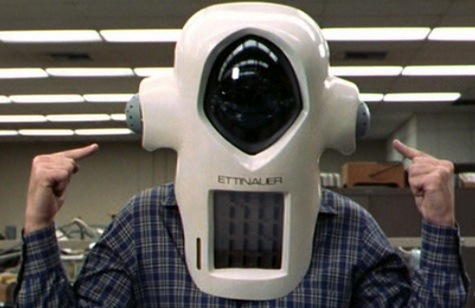
You talking to me?
Never mind the war of the worlds, here’s the world of the web.
A few weeks ago I wrote about the web coming to the world – the digitization of spaces like stores, restaurants, clubs, etc.
Here’s a delightful video in that vein by Patrick Jean:
via waxy.org/links
The debate over “democratic” computing, continued.
Nicholas Carr has written an excellent reflection on progress in consumer technology:
While progress may be spurred by the hobbyist, it does not share the hobbyist’s ethic. One of the keynotes of technological advance is its tendency, as it refines a tool, to remove real human agency from the workings of that tool. In its place, we get an abstraction of human agency that represents the general desires of the masses as deciphered, or imposed, by the manufacturer and the marketer.
For it before he was against it, finance journalism edition.
Ouch. Matthew Yglesias points out that Michael Lewis, now making mint by ridiculing banksters, only recently ridiculed their critics.